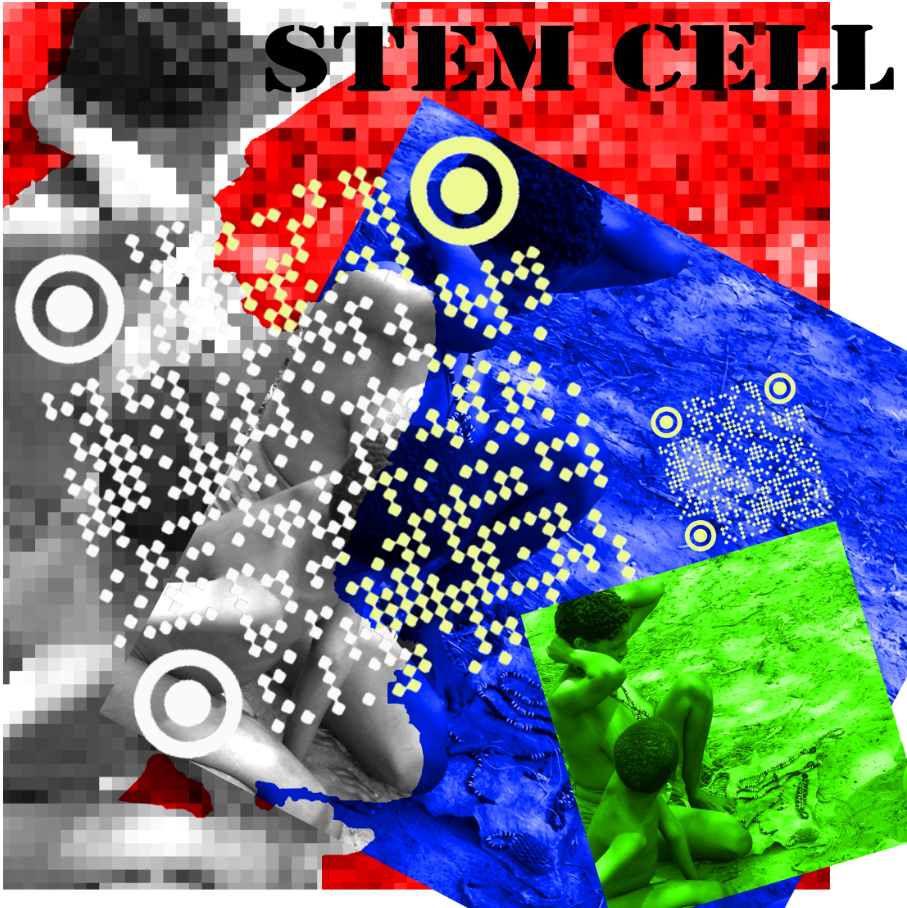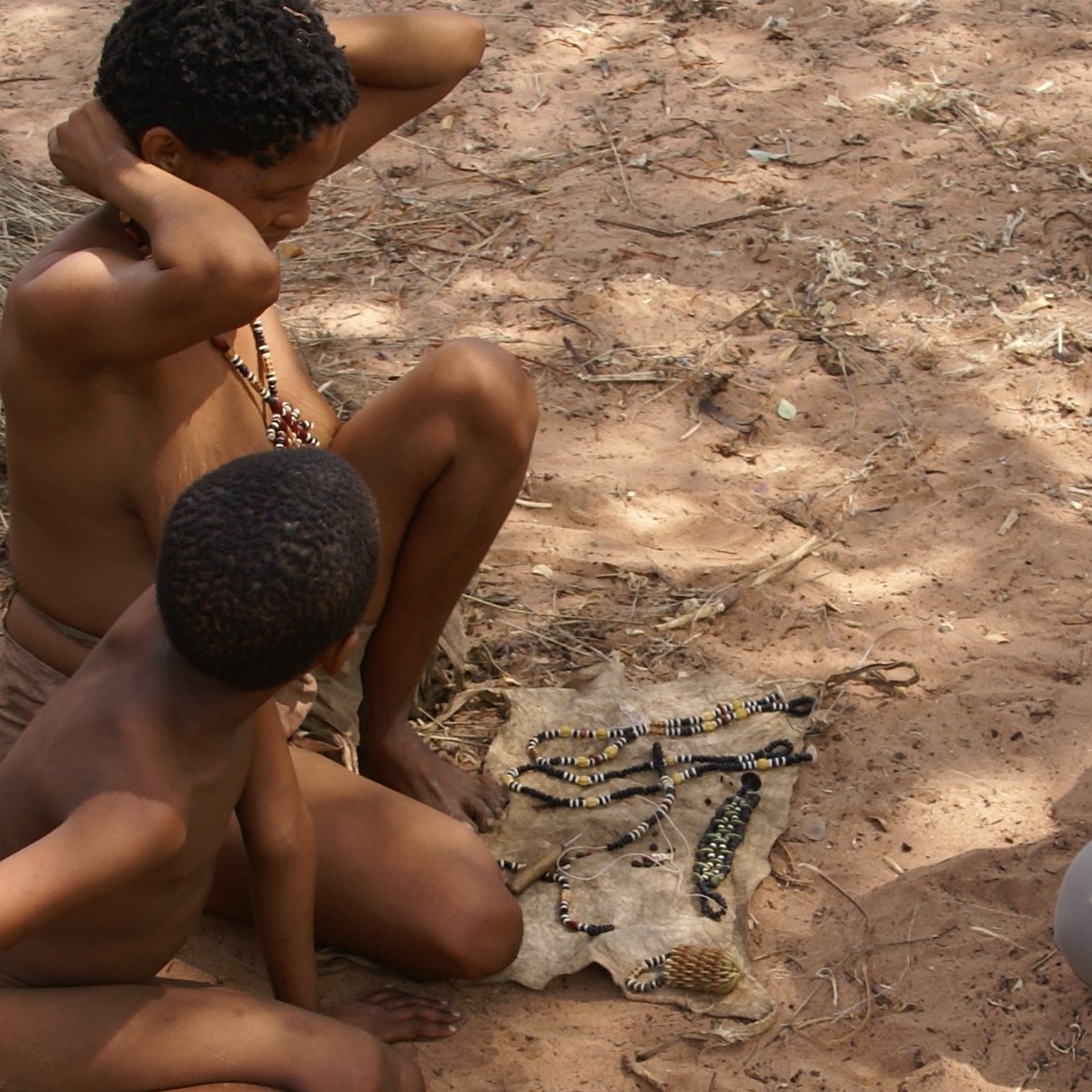
This artwork speaks to origins — biological, cultural, and ancestral. The fragmented images of San figures, multiplied and recolored in blue, green, and grayscale, echo both repetition and resilience. Like cells dividing, the figures suggest continuity of life, survival across millennia, and the persistence of memory.
The title STEM CELL evokes the foundation of life itself. Scientific studies have revealed that the San people carry some of the oldest and most unique DNA lineages in the world, connecting them directly to the earliest chapters of humanity. They are, in a sense, a living stem cell of human history — carrying within them the blueprint from which modern humans have branched.
The pixelated overlays, QR-code patterns, and sharp digital colors fracture the image, mirroring the way modernity dissects, analyzes, and categorizes life. Yet beneath this distortion remains the timeless human form, grounded in the earth, in ritual, in survival.
This work is not only about identity but about origins — about how every human shares a deep-rooted connection with these ancient lineages. It asks us to consider what it means to carry the memory of humanity in our cells, and whether in the rush of technology and science we risk losing sight of those who embody our shared beginnings.
The San people of the Kalahari Desert (also known as Bushmen or Basarwa) are one of the oldest populations in the world, and their DNA contains several unique genetic traits that distinguish them from other groups. Here are some of the most remarkable aspects of their genetic makeup:
1. One of the Oldest Genetic Lineages The San people belong to some of the oldest genetic haplogroups, particularly in their mitochondrial DNA (mtDNA) and Y-chromosome DNA. They carry haplogroups such as L0d and L0k in their mtDNA, which are among the oldest known human mtDNA lineages, dating back over 100,000–200,000 years. These haplogroups are believed to be closely linked to the earliest migrations of modern humans out of Africa. San men often carry Y-chromosome haplogroups like A and B, which are also among the oldest known lineages. These genetic markers support the theory that the San people are direct descendants of the earliest anatomically modern humans (Homo sapiens).
2. High Genetic Diversity The San people exhibit exceptionally high genetic diversity compared to other populations. Their long-term isolation in the Kalahari region has preserved ancient genetic variations that have been lost in other populations due to migration and admixture. Additionally, their traditional hunter-gatherer lifestyle, characterized by small, scattered groups with limited genetic exchange, has helped maintain this diversity.
3. Unique Genetic Adaptations The San people have developed specific genetic adaptations that help them survive in the harsh Kalahari environment. Some studies suggest they have genetic variations that improve their ability to retain water and withstand extreme thirst. Their bodies are also adapted to efficiently utilize energy from a low-calorie diet, typically consisting of nuts, roots, and wild game. Furthermore, they possess genetic traits that aid in thermoregulation, helping them withstand the high temperatures of the desert.
4. Low Genetic Admixture with Other Populations The San people have less genetic admixture with non-African populations compared to many other African groups, largely due to their historical isolation. However, there is evidence of limited genetic exchange with Khoisan-speaking groups and Bantu-speaking populations in more recent times.
5. Linguistic and Cultural Traces in DNA The San people belong to the Khoisan language group, which is known for its use of click consonants. While some researchers have speculated about a potential genetic connection between their unique language and DNA, this remains an open area of research.
Significance of the Research Studies of the San people’s DNA have provided valuable insights into the origin of humans and their migration out of Africa, evolutionary adaptations to extreme environments, and the role of genetic diversity in health and disease.
Ethical Considerations Research on the San people’s DNA has raised ethical questions about consent and exploitation. Many San groups have demanded greater control over how their genetic data is used, and some studies have faced criticism for not respecting their rights.