By the time we arrived in the village, clouds hung low over the thatched roofs, smoke slipped out from the huts, and bare feet moved quietly over dark, damp earth. Everything felt contained, almost timeless, as if the valley had folded in on itself and decided to keep its secrets.
Somewhere in my backpack, among camera batteries and notebooks, was a small yellow balloon. It was nothing special where I came from – the kind of thing that gets trampled at the end of a children’s party – but in my pocket that day it felt like a strange little ambassador from another world.
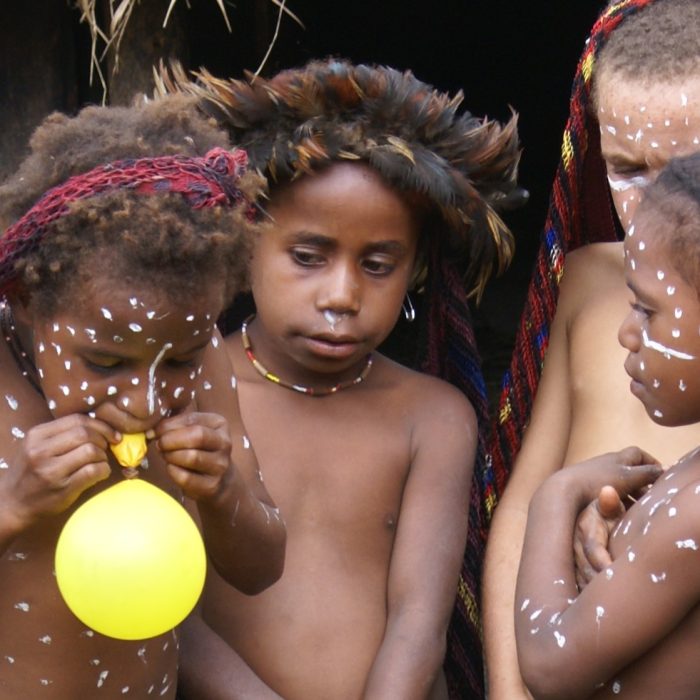
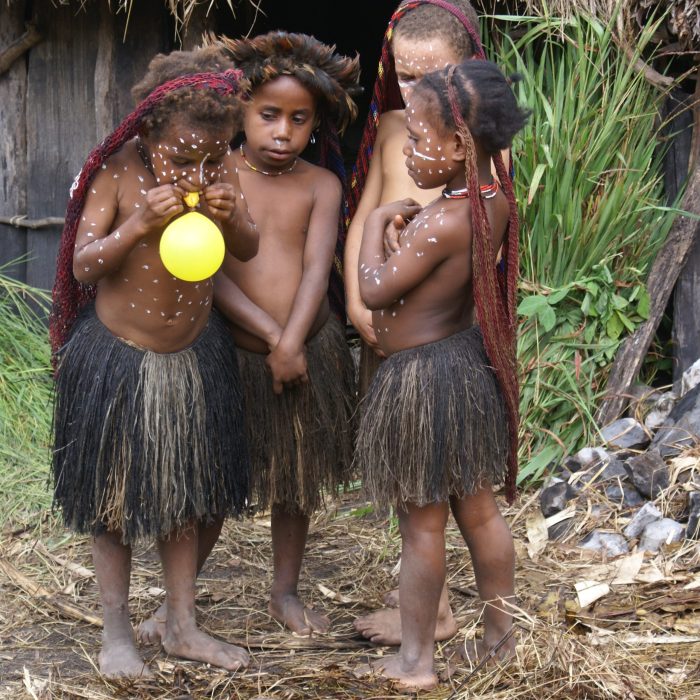
When I pulled it out, the children saw it immediately. One of them stepped closer, painted with white dots, hair rough and beautiful under a scarlet net of fibers. I held the balloon out and she took it, cautious at first, then with growing confidence. She pressed it to her lips and began to blow.
That was the moment everything shifted.
Her cheeks filled with air, eyes narrowing in concentration. The balloon grew round and bright between her hands, a small sun hanging in front of her chest. Around her, other children closed in – one with a feather headdress, another with arms folded, painted patterns running down her brown skin. An adult leaned in from the side, watching just as intently as the children. For a few seconds, the entire world seemed to shrink to the rhythm of one child’s breath.
I remember thinking how absurd and beautiful it was. This piece of cheap rubber, manufactured in a factory far away, had somehow travelled across oceans and mountains to arrive in the hands of a Dani child in a remote valley of West Papua. It didn’t belong to their world, but in that instant it was completely theirs. No instructions, no manual, just curiosity. Breath. Expansion. Laughter waiting just under the surface.
The scene raised questions I am still not finished with.
What does it mean when the “modern world” enters a traditional one in the form of something so trivial and so bright? Is it innocent play, or the first thin edge of a wedge that will eventually split everything open? The yellow balloon was fun – the children were excited, absorbed, happy – but it also felt like a symbol of something larger: the slow, unstoppable arrival of the outside world in a place that had remained relatively closed.
At the same time, I saw something universal. Children anywhere in the world would have done the same. They would gather, stare, giggle, test the limits of this strange object that grows when you breathe into it. Play is a language older than borders, older than technology, older than me standing there with a camera in my hands. In that small circle of bodies, I saw how human we all are, long before we are “modern” or “traditional.”
Later, when I looked at the photographs, the scene kept pulling me back. Four children in grass skirts, white paint on their bodies, standing barefoot in front of a dark hut. One girl inflating the balloon, the others watching with a mix of boredom, curiosity, and silent awe. There was something almost ritualistic about their poses, as if a new ceremony was being invented on the spot, with a balloon as the sacred object.
I knew this couldn’t remain just a document. It needed to become a work of art.
Partly because the moment itself was rare – few people ever make it to that village, fewer still witness such an unfiltered, shared curiosity – but rarity alone isn’t enough. It needed to become art because the image held a question that demanded more than a caption under a photograph. It asked: what happens at the precise point where worlds meet? When an object of modernity enters a space shaped by tradition, who changes whom?
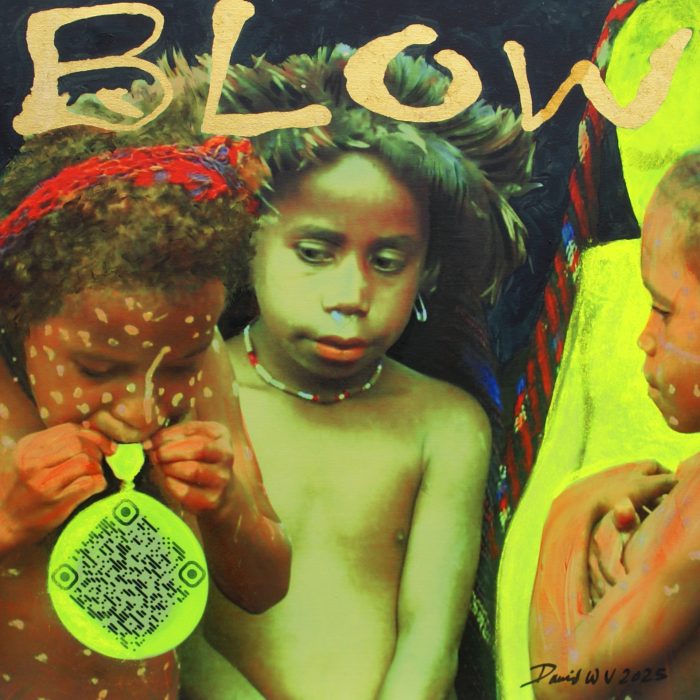
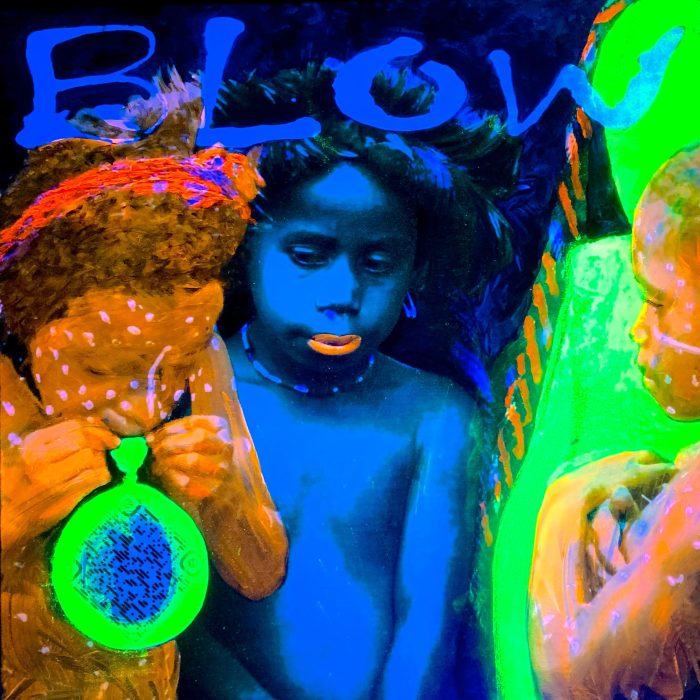
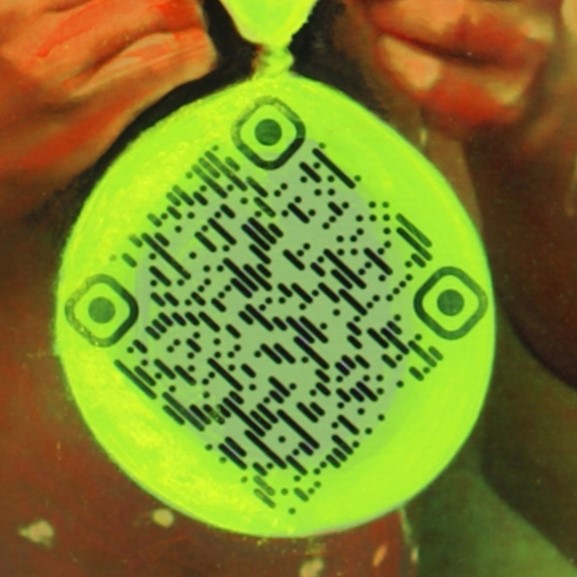
So I pushed the image further. I amplified the colors until the skin turned electric green and the background glowed orange, like a warning sign or an advertisement. I added the word “BLOW” across the top, crude and loud. I embedded a QR code into the balloon, turning it into a portal that leads back to the story behind the scene. In doing so, I made the tension visible: the children still stand there in their own world, but now they are wrapped in the visual language of mine – digital, fluorescent, branded.
The artwork becomes a mirror held up to both sides.
To the viewer, it looks almost like a poster: bright, simple, eye-catching. But when you look closer, you see the details – the white paint, the bare feet, the serious eyes of a child who is not simply “cute,” but present, rooted in a specific culture and place. To me, the piece is a reminder of my responsibility: I arrived as a visitor with a camera and a balloon, and I left with images that could easily have become just another exotic picture. Transforming it into a deliberate artwork is my way of slowing down that gaze, forcing it to linger, to ask questions instead of just consuming.
This experience had to become art because art can hold complexity in a way a snapshot cannot. It can carry the joy and innocence of children playing, the unease of cultural intrusion, the beauty of shared humanity, and the discomfort of my own role in the scene – all at once. The balloon will one day deflate, the children will grow up, the village will change. But in the artwork, that fragile sphere of breath and color remains suspended, inviting others to stand before it and feel, for a moment, what I felt in that Dani village in the highlands of West Papua: wonder, doubt, tenderness, and the sense of standing at a small but significant edge in time.