
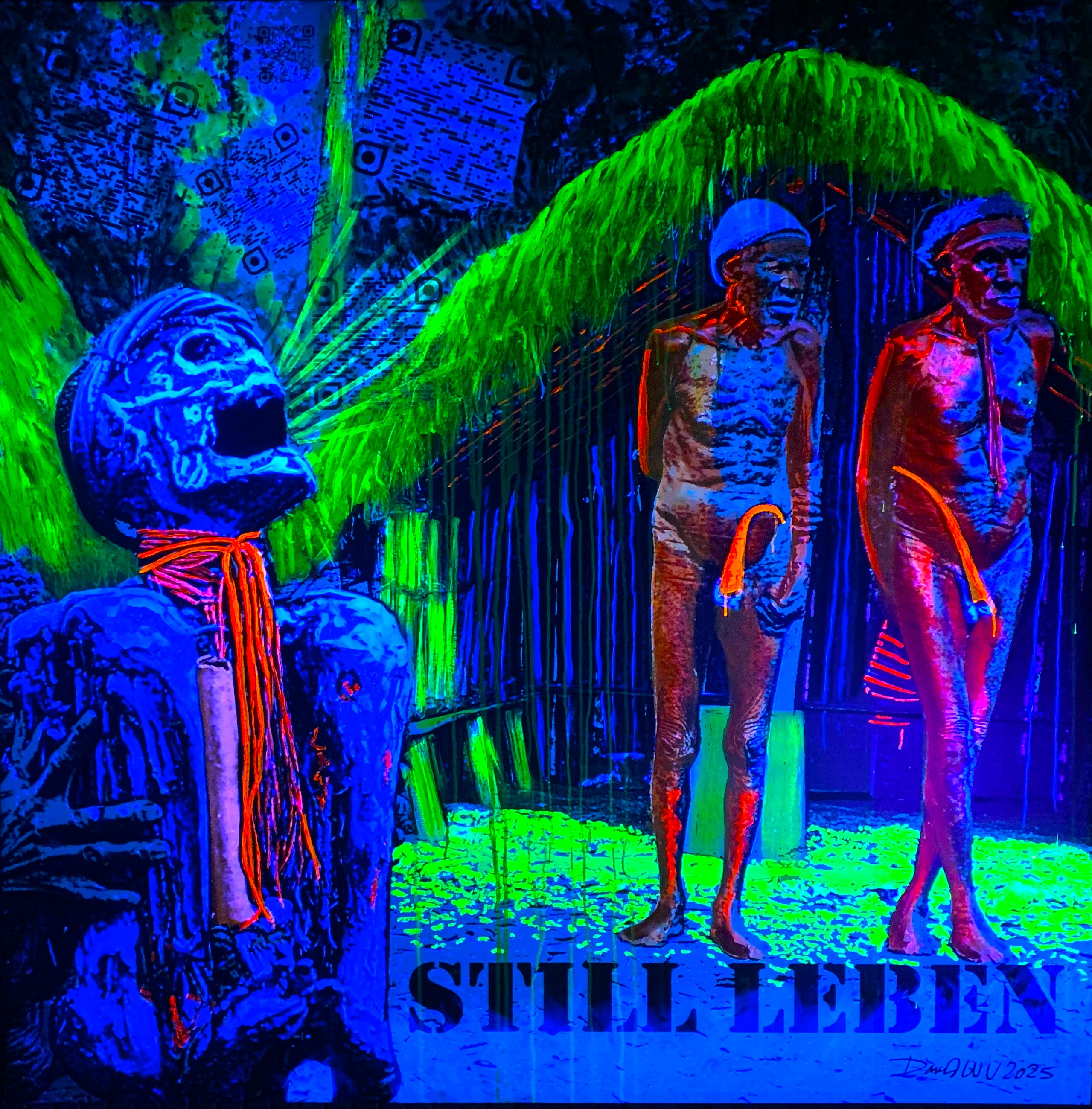

The Mummy in Sumpaima Village
We continued on to another village to see one of the famous mummies. It wasn’t something that immediately interested us—which is strange in itself, since we normally make it a habit to seek out burial rituals and peculiar gravesites. But for some reason, the idea of mummification didn’t really show up on our “to-do list.”
It turned out to be an interesting experience, though. We had expected a rather touristy affair, which it was in a way. They knew they could make money by charging for pictures of the people. But they didn’t want payment for pictures of the mummy itself. So, of course, we limited ourselves to only taking pictures of it. I’m happy to give money, but I hate having to think about payment when I’m working with my cameras. So, I avoid it as much as possible. If a situation arises where it’s more natural to give a small donation, I’m happy to do it, as I said. But here, old women came rushing up, showing their hands with almost every finger shortened by one or two joints. They wanted me to take pictures of them and their truncated fingers. I found it directly repulsive and had no need to “get those pictures in the can.”
We had imagined that the mummy would be neatly placed on a pedestal or something similar inside one of the huts and that we would be invited in to get a glimpse of the phenomenon. However, that wasn’t the case. We were indeed led to one of the huts and asked to wait politely outside while one of the elders crawled inside.
We expected that he would prepare something inside in the darkness before we could enter. But no, instead he came carefully crawling out of the small door with the old mummy in front of him. When he was completely out, he placed “the thingamajig” on a chopping block and squatted behind it so we could study it and take pictures—and we took lots… mummy with the mummy keeper, mummy with two elders in the background, mummy with a young man in the background, mummy with elderly women in the background, and so on.
Yeah, yeah, it was cheating, but so what? I can light a candle next time I’m in St. Peter’s Basilica, or pray to Allah six times in a single day, or put out two Cokes for my Buddha instead of just one… I’ll seek forgiveness!
Mummification was an important part of the Dani culture. The preserved body of the village’s great man—an elder, a chief, or a great warrior—was considered a link to the ancestors. Most villages consist of members of an extended family and can almost be described as a family collective. And the mummy is the oldest member, who holds great significance for this sense of community.
As part of the preservation process, the body is hung up in a specially built hut over a fire and is constantly smoked for up to two years. First, the body is hung from the ceiling and all the blood is drained by making cuts all over the body. For two months, the men performing the mummification are only allowed to eat baked sweet potatoes and a sauce prepared with ginger. When the mummification process is complete, a large feast is held where many pigs are slaughtered. Our mummy friend is named “Wimontok Mabel,” a famous warrior from about 250 years ago. His clothing and decorations are the same as what his descendants wear today, so not much has changed.
The Indonesians consider this tradition barbaric and have forbidden these rituals. They have confiscated and destroyed most of the mummies in the area, and there are only three that have survived in the Baliem Valley. However, it is believed that a number of mummies are still hidden away and thus unknown to the authorities in Jakarta.