Against the Mirror: A Parable of Possession and Belonging
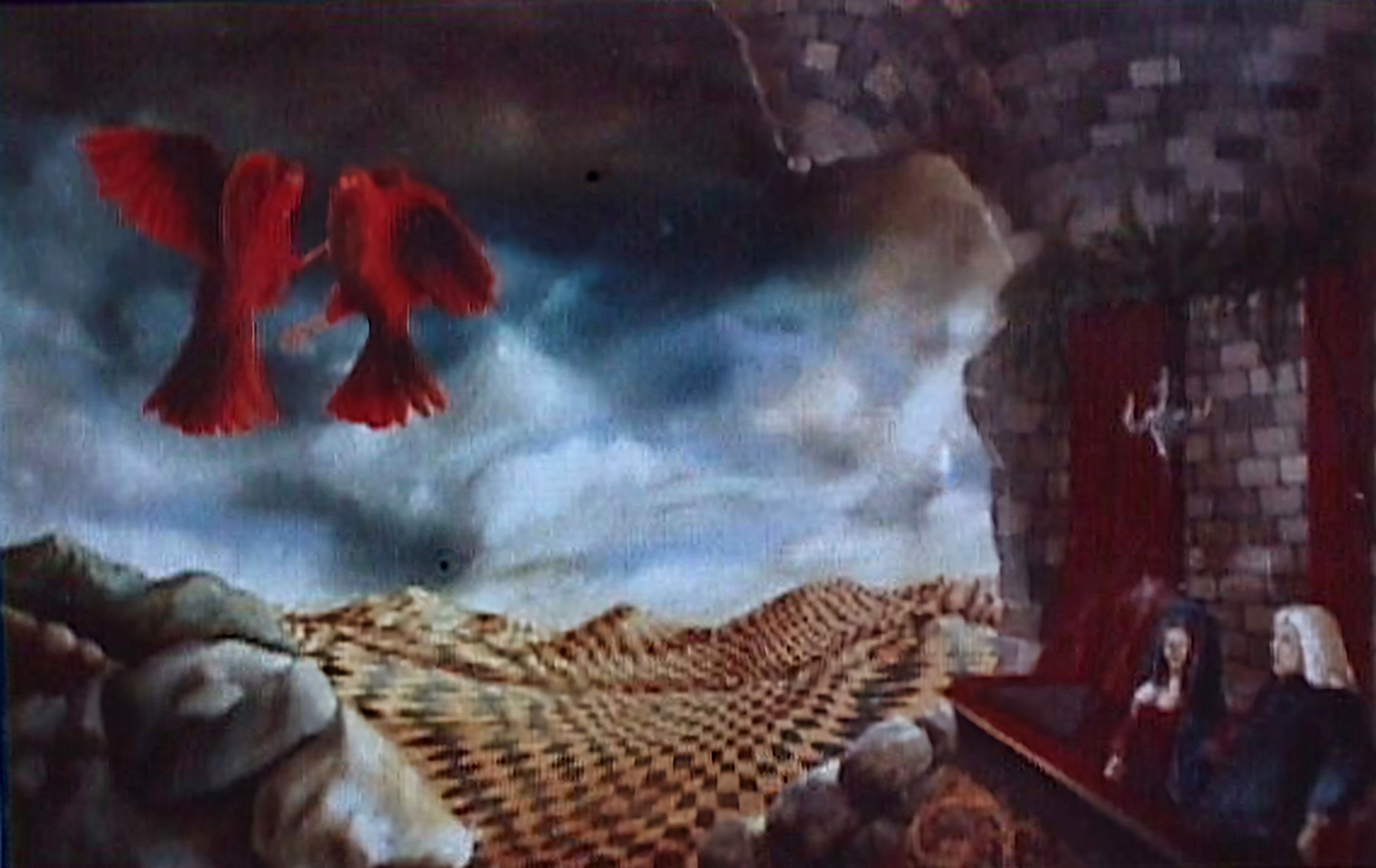
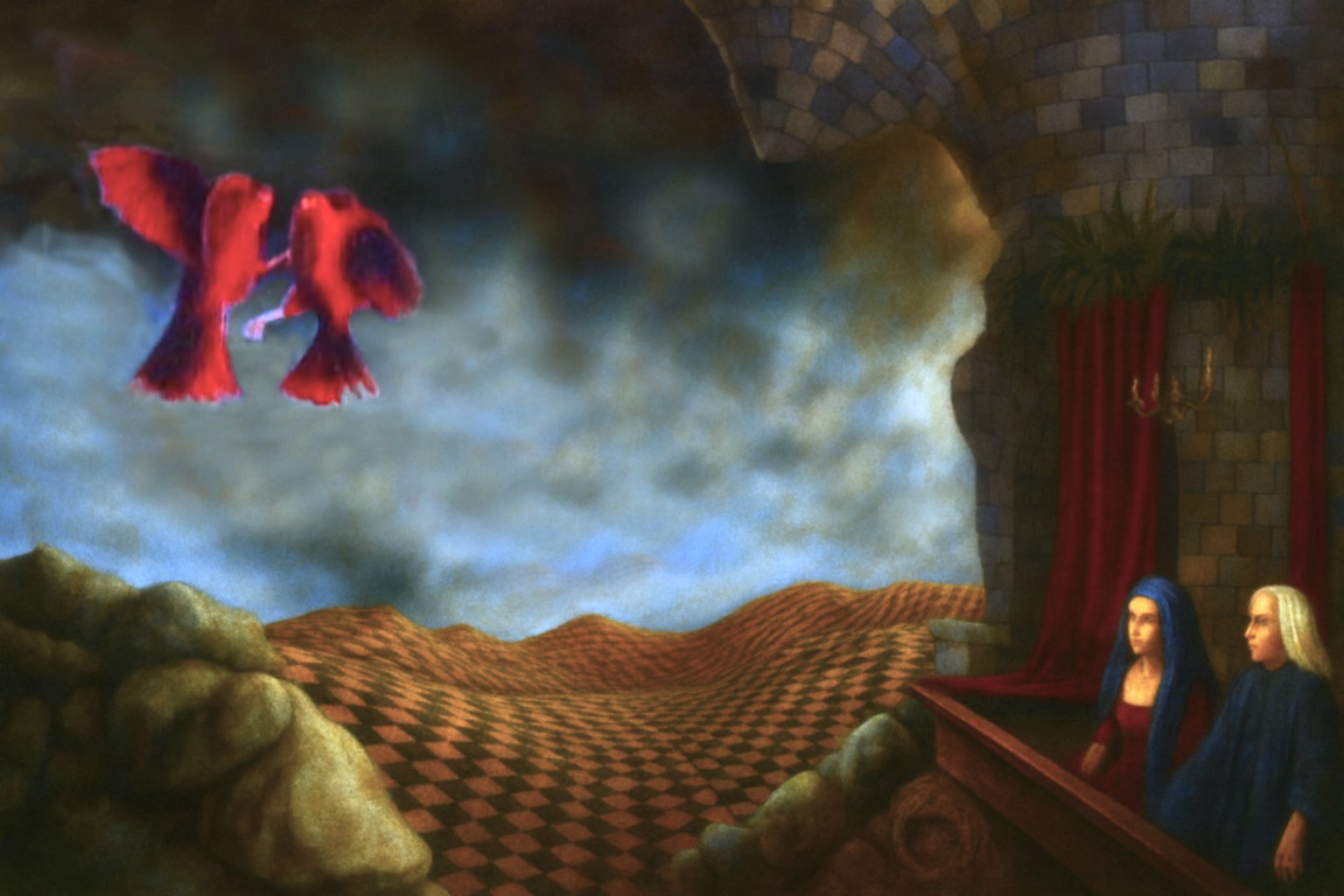
A storm-pressed sky lowers over a land counted into obedience: the ground is a chequerboard, impressive and airless. To the right, a castle wall of rough boulders opens into an arch. Two finely dressed, medieval-looking figures sit within, perfectly intact and perfectly still. Cobwebs stitch their sleeves and the masonry around them, time writing in silk where life refuses to move. Above their heads, fixed to the very stones that shelter them, hangs a stone breast—a mounted relic with its blunt nipple facing outward, part votive, part trophy, part indictment.
In the air before this balcony, two red birds collide—twins in outline until the eye understands that one is only the other returned. The duel is inward, a creature testing itself against its reflection, learning its edge by resistance. That turbulence is the weather of becoming. Below, the measured land displays the opposite fate: control without sap, ownership without growth, a geometry of famine masquerading as order.
The mounted breast concentrates the charge. Once a promise of nourishment, it has been lifted out of the living body of earth and installed as ornament above the owners of the view. What should flow has been fixed; milk has been converted into mineral and then curated as a symbol of possession. The placement is the message: nurture made unreachable, turned into an object to be looked at rather than received. The spectators preside beneath it like parishioners under a relic that will never feed them, their stillness slowly turning them to stone.
The painting’s argument is plain. First, our fiercest quarrels are with ourselves; survival requires that difficult recognition. Second, a world mastered into squares loses the very life it seeks to guarantee. Third, spectatorship without participation—owning instead of belonging—converts gifts into trophies and people into pedestals. The work invites us off the balcony and into weather: to trade custody for reciprocity, distance for touch, display for use. Only then could the breast descend from the wall and become milk again; only then could the bird fold back into one flight; only then might the chequered ground remember how to grow.
Note
Left: The original photo of the painting was in poor condition and slightly out of focus. I’ve used AI to improve clarity as far as possible while keeping the original look and feel.
Right: To recreate the idea of the painting, I asked ChatGPT to generate a similar scene. The landscape and figures came out well, but the two fighting birds looked overly digital. I therefore overlaid the birds from the blurry original onto the AI image. The result is serviceable, but still not ideal.
Passage of time
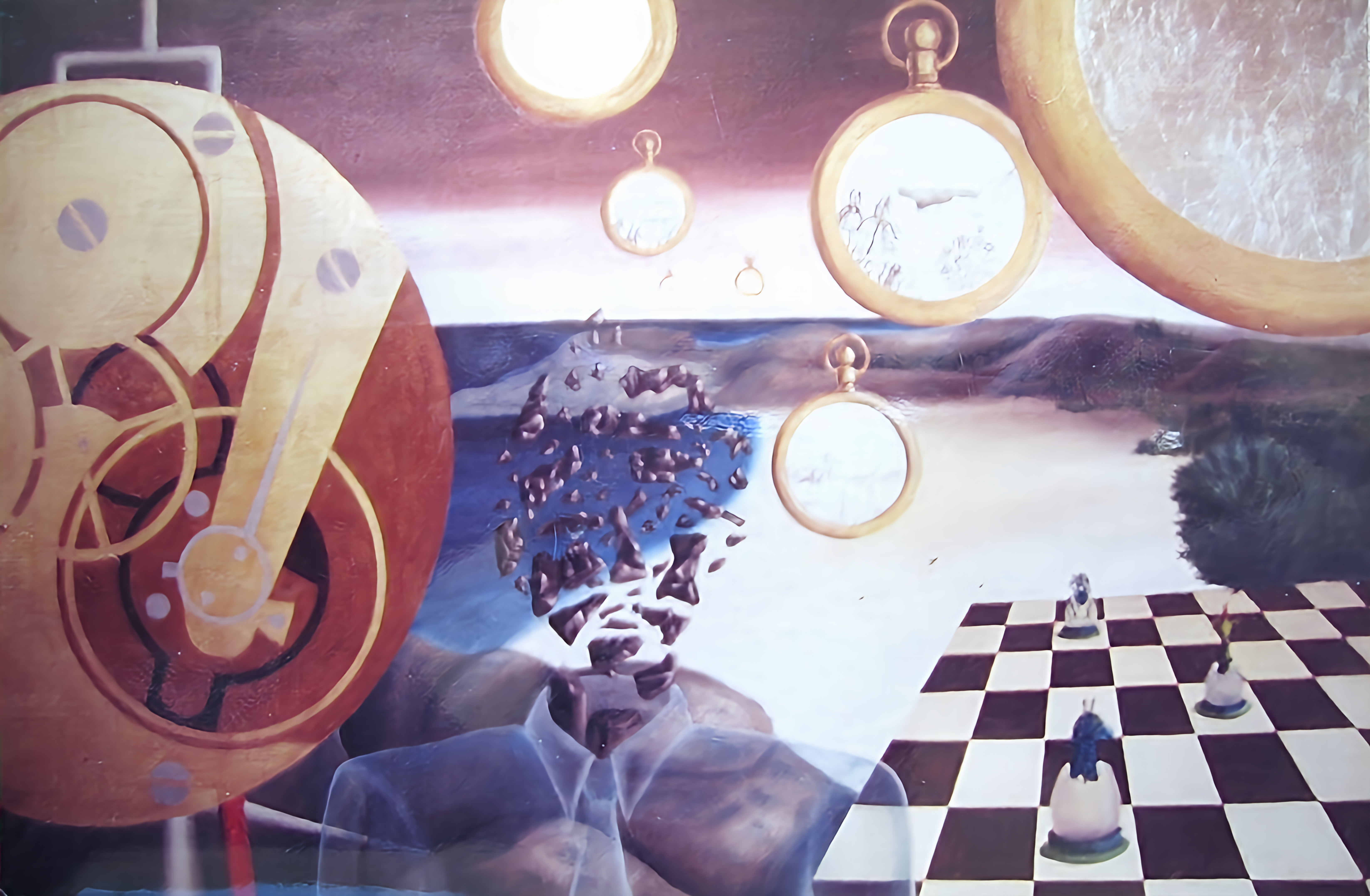
A vast, pale horizon opens like a blank page. At the left, a watchmaker’s anatomy—cogs, wheels, levers—swells to the size of a planet. Across the sky, gold-rimmed pocket watches drift like small moons, their faces turned outward as if time itself were on display. In the foreground a suited bust begins to unmake itself: the head fractures into dark shards and lifts away on a salt wind. To the right, a chessboard juts into the landscape, its squares crisp against the sand; on several of them, strange rook-like forms stand as if newly hatched, half tool, half creature.
The painting wears its surreal lineage openly—Dalí’s metaphysical clocks, Delvaux’s stage-lit hush, Magritte’s calmly impossible juxtapositions—yet Passage of Time adds its own argument. The gearwork and the drifting watches are two kinds of time—mechanical and celestial, measurable and immeasurable—coexisting uneasily in the same sky. The dissolving head shows what time does to identity: it edits us, flake by flake, while convincing us we remain whole. The chessboard proposes a human scale—every move a choice, every choice a consequence—laid like a rational grid upon a world that refuses to stay still.
Materially, the work deepens its illusion. It is painted in acrylics, then heightened with gold leaf and aluminum leaf so the watch faces and metallic mechanisms throw back real light. Those reflective planes don’t just depict time’s shimmer; they physically catch it, asking the viewer to move, to measure, and to notice themselves glinting inside the scene.
Peaking the Cardinal (1978)
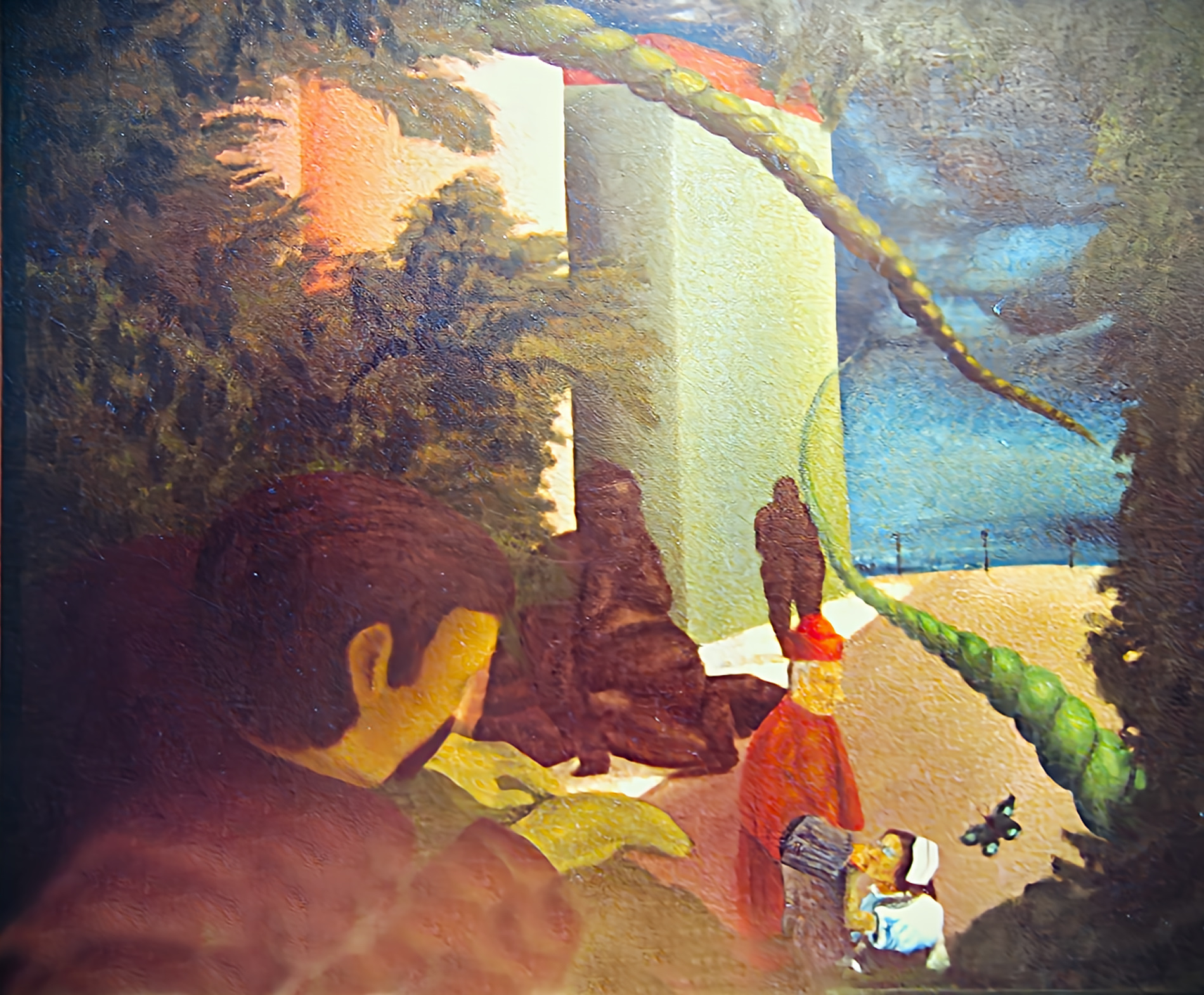
A seaside courtyard opens like a stage seen through leaves. In the foreground a hidden onlooker—half concealed, half complicit—watches a nurse bow to a cardinal and kiss his hand. A butterfly lifts from the meeting and angles toward the light, a small, insistent emblem of departure. Along the curved wall two giant black figures appear: one bald and seated, heavy as an anchor; the other rising and drifting toward the sea. The vine that arcs across the scene feels like an umbilical cord, tying this ceremony to something older than ritual.
These doubled presences are the picture’s key. The seated shadow is what grief looks like when it refuses to move—left behind, dense, almost mineral. The standing shadow is grief in motion, the part that begins, however slowly, to leave the courtyard and trust the horizon. Between them, the nurse and the cardinal enact a familiar exchange of care and authority, while the butterfly—soul, breath, memory—chooses air over architecture. The hidden witness is the dreamer who has stepped aside to let the scene declare itself.
Painted just after the artist moved into a funeral home in Vancouver, Washington, the work reads like a waking dream about thresholds. Institutions bless, caregivers tend, the living look on—yet something larger is happening at the edge of sight: heaviness loosening, a spirit taking flight, and the sea waiting with its patient blue.
Penguin in a Veil (1979)
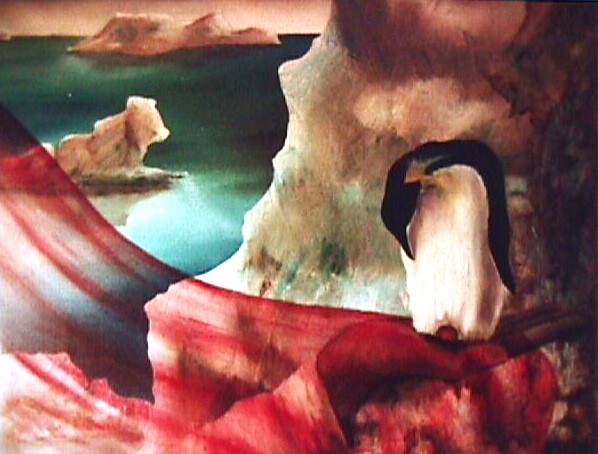
A lone penguin stands on a ledge of ice, robed by a dark “veil” of shadow and plumage. The sea below is a cold green, broken by bergs that drift like slow thoughts. Across the ice runs a crimson drape—part cloth, part glacial stain—that settles near the bird’s feet. There, small and unmistakable, lies a red golf ball.
At the level of story, the scene reads like a fable of substitution. A creature known for guarding a single, precious egg confronts an object that looks egg-like but belongs to another world—the world of leisure, measurement, and rules. The penguin’s posture is contemplative, almost priestly; the red ball is comic and sinister at once. It’s as if the nest has been swapped, life exchanged for a toy.
The veil gives the image its metaphysical charge. A veil hides and reveals; it turns ordinary material into ritual. Here it suggests the thin membrane between nature and our inventions, between meaning and its imitation. The red drape—blood, warning, ceremony—lays human drama on top of a landscape that does not ask for it. The golf ball becomes a false planet, a counterfeit egg, a bright decoy for the instinct to nurture.
Read this way, the painting asks a stark question: What happens when symbols replace the things they signify? The penguin stands at the threshold between care and misdirection, between the ache to protect and the seduction of the trivial. The ball’s dimples echo craters on a tiny world; the penguin, cloaked like a monk, considers whether to give itself to an illusion.
So the humor bites. The work is playful—but it is also an allegory of modern life: living beings tempted to incubate the wrong objects, to veil the real with bright distractions. In the quiet of polar light, the painting holds the moment of choice and lets it ring.
After Eden (1979)
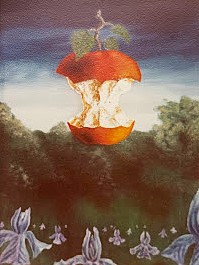
After Eden (1979) is a small miracle of restraint. In a twilight grove, a bitten apple floats as if canonized—the red peel intact at crown and base, the gnawed center shaped like an hourglass. A fringe of blue-violet flowers looks up like a quiet choir. Acrylics carry the scene; gold leaf gives the fruit a lit edge, the way relics glow in chapels.
It is an image of desire once satisfied and now thinking of time. We have taken the sweetness; what remains measures us back. The polished peel—branding without substance—frames absence so beautifully that we almost revere it. Yet the stem still wears green leaves: life persists even when the core is gone. The painting holds us between fall and renewal, asking a disarming question: do we love things for what they give, or for the shine they leave after we’re done?
Standing at the Threshold (1980)
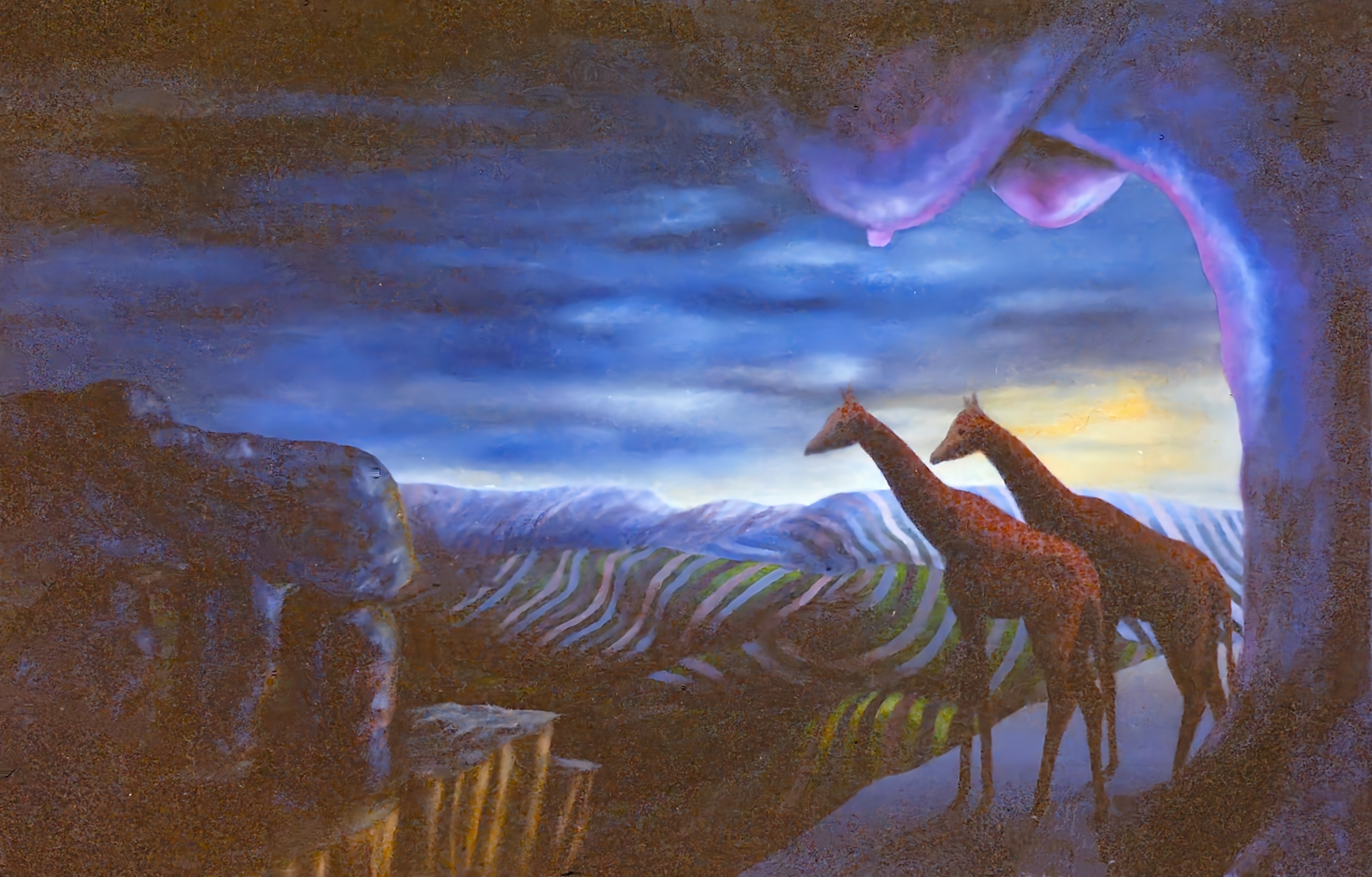
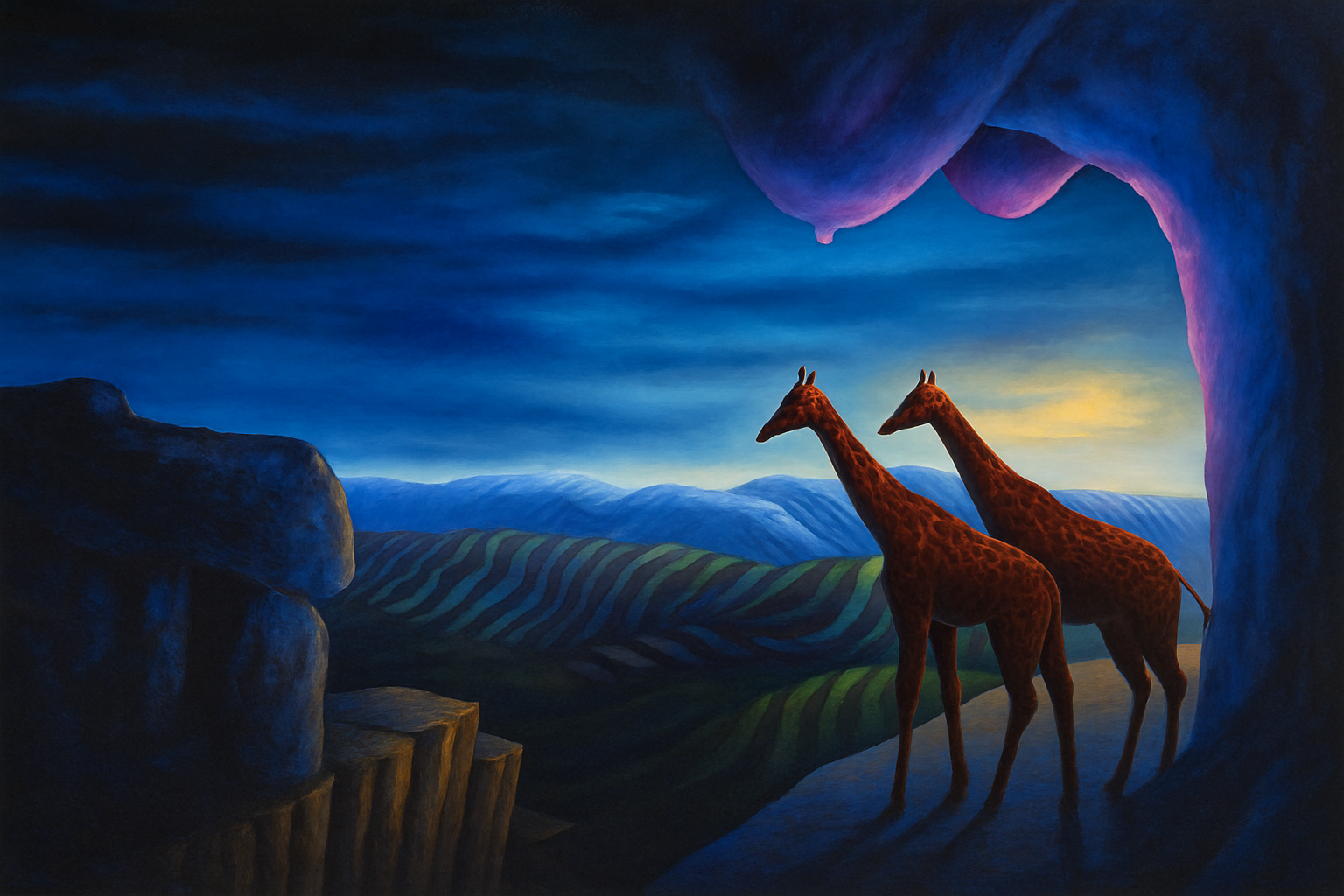
We meet the scene from the mouth of a cave. The interior is dark and textured, and the world beyond opens like a stage: a sky heavy with blue-grey weather, a pale seam of light at the horizon, and a land that rolls away in rhythmic, striated bands of brown, green, and ash. At the right edge, two red-toned giraffes stand alert, their long necks angled toward the clearing light. To the left rises a hulking megalith that could be a monument or the profile of a weathered face. Overhead, the cave’s ceiling swells into a soft violet form—part cloud, part body—hovering like a protective, strangely intimate canopy.
The painting builds its story with contrasts. Warm animals against a cool sky; a shadowed interior framing a luminous distance. The eye travels diagonally—from the stone mass at left, across the patterned hills, to the giraffes and on to the horizon—so that looking becomes a kind of journey. The land’s striped rhythms echo animal markings, as if the terrain and its creatures share a language of pattern and adaptation.
Each component carries weight. The giraffes are the emotional center: embodiments of watchfulness and reach, built for distance and foresight. As a pair they speak to companionship—two travelers pausing at the same question. The megalith anchors time; it suggests ancestry and endurance, a mute witness that has seen passages before this one. The cave opening works like a proscenium and like a womb: a place of shelter, memory, and origin. That breast-like swell overhead hints at nurture and beginning, making the whole view feel like a moment of emergence.
On the red of the giraffes: choosing red instead of the usual ochre un-naturalizes the animals just enough to turn them from zoology into symbol. Red reads as warm blood and risk, urgency and birth; it is arterial, not merely epidermal. It links the giraffes chromatically to the cave’s fleshy ceiling—creatures of the open plain momentarily claimed by an interior, bodily space. The red also charges their stance with alertness: they are not only surveying distance; they are ignited by it. Against the blue-violet weather, that red becomes a flare—an announcement of will, desire, and life moving forward. One can even hear an echo of Paleolithic reds in cave paintings: the animals here are not portraits but archetypes, carriers of heat and intention.
The land in between is restless—furrowed, wave-like, striped. It reads both as cultivated field and as a natural zebra of earth, and in that ambiguity the painting stages a conversation between nature and culture. Are we crossing a tamed landscape or reading nature’s own script? Either way, the path runs toward a thin, bright band where the sky relents. The weather is unsettled but not hopeless; a break appears. The giraffes are turned to it, and so are we.
Taken together, these elements shape an image of liminality—life in the doorway. We stand with the animals in a threshold space, held between the intimacy of the cave and the call of the open. Behind us is origin and stone memory; above us, the trace of nurture; ahead, a world that is at once familiar and strange. The painting suggests that to step forward is to be reborn: to leave shelter while carrying its strength, to accept the weight of the past and still seek the horizon.
Painted in 1980, the work sits in a surreal, symbolic tradition where landscape doubles as psyche. It invites us to feel the hush before movement, to recognize the pull of light under a storm, and to acknowledge the courage it takes to look far and then go. In the end, the red giraffes become proxies for our own attention—tall, ardent, and awake—holding the instant when seeing turns into choosing, and choosing into journey.
Editor’s note (about the images)
Two images accompany this text. The left-hand image is a low-quality, digitally adjusted photo of the original 1980 painting. The right-hand image is an AI-generated visualization, produced to approximate the composition, color balance, and edge clarity of the original. It should be read as an interpretive aid—not a substitute for the artwork itself.