
Interpretation of “Heads & Tails”
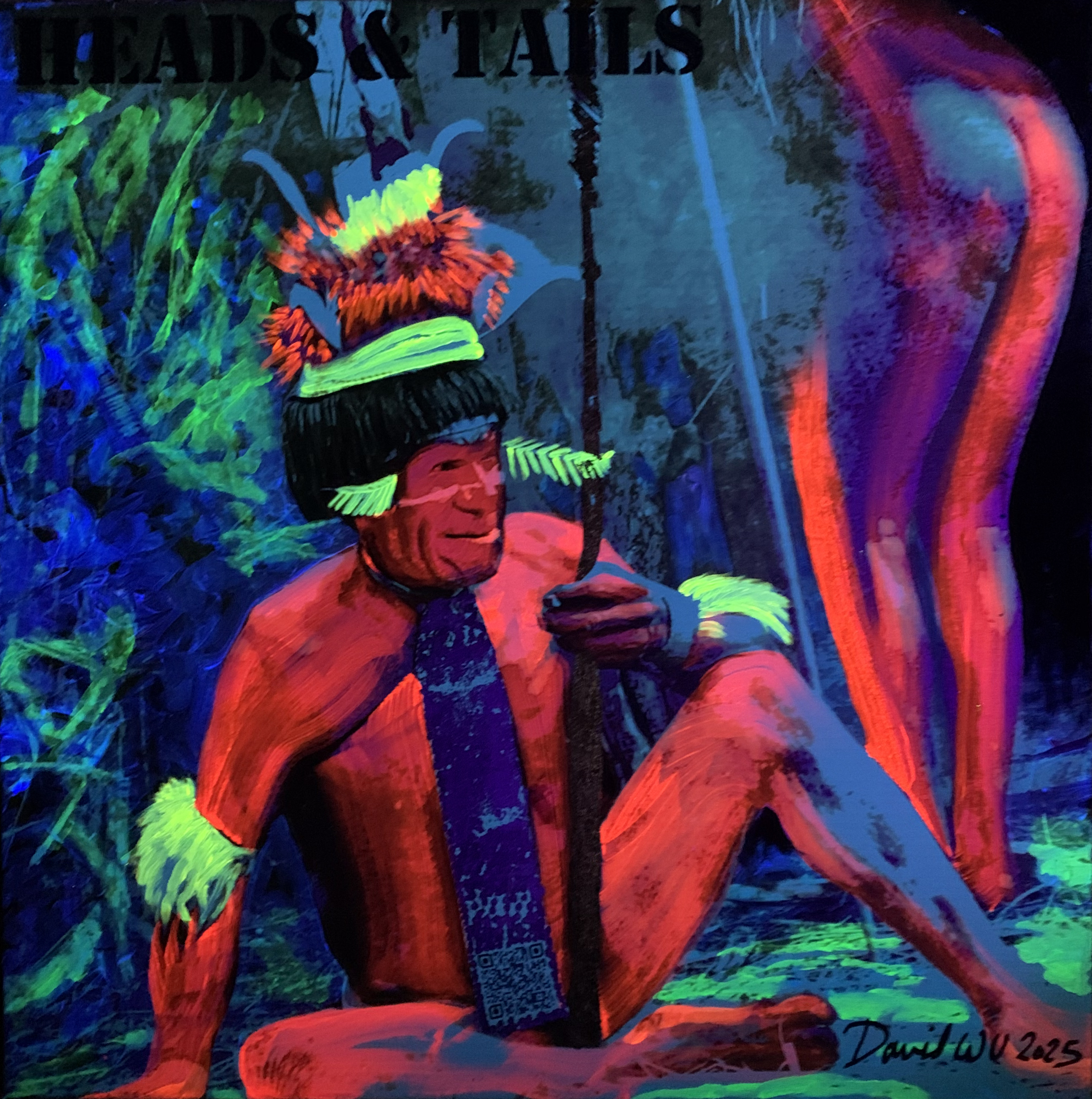
In the original photograph I am sitting on the ground in front of the Dani men’s house in the Baliem Valley, watching the slow choreography of a Pig Feast unfold. The earth oven is placed in the middle of the yard, and smoke drifts across the open space between house and fire, carrying the smell of hot stones, earth and meat. A man sits in the foreground, relaxed but alert, his body painted, his calves and arms wrapped in fur, a long chain-like adornment hanging from his neck. The headdress of fur, feathers and horns crowns him like a small portable landscape – part bird, part animal, part spirit. Behind him, another man bends into the men’s house, his back turned, his body completely exposed.
Already in the photograph there is a quiet tension between the two figures: one face, one back; one resting, one working; one framed by regalia, one almost anonymous. In my memory this is a pause in the preparations for the feast. The earth oven in the middle of the courtyard is being tended, pigs, sweet potatoes and greens packed between hot stones and layers of grass and leaves. The men move between fire, house and yard, and from time to time someone sits down, smokes a cigarette, watches, waits. Nothing is staged for the camera. It is simply the rhythm of a day where an entire village cooks together.
In the artwork Heads & Tails I have pushed this moment far away from documentary realism. The colours have been boiled down to incandescent reds and yellows, as if the whole scene is lit from within by the glow of the earth oven. The seated man in front becomes almost sculptural, his body cut out in fiery tones against the background. The text HEADS & TAILS at the top plays on several levels at once: the proud head in full ceremonial dress on the left, the naked “tail” on the right; the front and back of the body; and the familiar coin-toss of chance and fate in our own culture.
I am interested in how we, as Western viewers, look at nakedness. The Dani do not walk around thinking about “nudity” the way we do; the penis gourd, the headdress and the ornaments carry the meaning, not the absence of clothing. In the artwork the fierce colours exaggerate both dignity and humour. The seated man smiles, caught mid-gesture with his staff, while the backside at the men’s house entrance becomes almost abstract, a shape of light and shadow. The scene is playful, but it also asks who is head and who is tail in the way the world looks at indigenous people: are they allowed to be full personalities, or only bodies and surfaces?
The QR code, placed like a small digital ornament on his chest piece, ties the image directly to our own world. Where his neck decoration is made from countless tiny elements woven together by hand, the QR code is another kind of weave – pixels forming a pattern that only reveals its meaning through a smartphone. For the Dani man, status is communicated through feathers, fur, pig wealth and participation in ritual. For us, status is often measured in information, connectivity and the ability to scan our way to context. In Heads & Tails these two systems sit side by side on the same body.
Scanning the code opens the story behind the image: the journey into the valley, the Pig Feast, the earth oven in the courtyard, and the way food, ritual and community life are inseparable. It is my way of insisting that this is not just an exotic, visually striking scene, but a living culture with names, voices and histories. The bright, poster-like treatment borrows the language of advertising – the same visual grammar that sells soft drinks and sneakers – and turns it toward a different purpose: to announce that these people exist, still, now.
For me, Heads & Tails is ultimately about balance. Between respect and humour, between body and headdress, between tradition shaped by smoke, grass and pig fat in the open yard, and a tiny black-and-white code anchored in our digital present. The man in front sits comfortably in both worlds: rooted in his own, and at the same time projected into ours through colour, text and QR. If there is a coin being tossed here, I hope the image helps it land not on “us” or “them”, but on a shared curiosity about how many ways there are to be human.
The Indigenous Project
I have traveled across the World in search of tribes whose lives unfold at the margins of modernity. I have met them, shared moments in their presence, and recorded fragments of their cultures through the lens of my camera. These encounters became short films and photographs, though what I could share publicly was often pared down, restrained by the conventions of media platforms that recoil at the sight of the human body as it exists beyond Western norms.
The Indigenous Project is my attempt to move beyond those limitations. Here, the stories and photographs are not confined to the silence of censorship but are reimagined through visualization, digital transformations of my original images, touched only lightly with the paintbrush. They are not paintings in the traditional sense, but hybrid works: photographs reborn with artistic intention.
Rather than whisper quietly from a museum wall, these works take on the voice of advertising. They carry themselves like billboards on a highway—loud, direct, unafraid. They do not seek subtlety but insistence, calling out to the public about the existence of these tribes. They echo the urgency of survival, the need to be seen, the struggle not to vanish unnoticed into the background of the modern world.
The peoples I have visited live at the farthest edge of the present, caught between the continuity of tradition and the intrusions of global modernity. They adapt, resist, and reinvent—some finding tenuous stability in the currents of cultural tourism, others holding fast to older ways. My hope is that these visualizations, bold and insistent, will amplify their presence, carrying fragments of their realities into spaces where recognition matters.
The project is envisioned as a constellation of five large-scale works, each 150 x 150 cm, accompanied by fifteen smaller works of 72 x 72 cm. Together, they form a chorus, urgent, vivid, and impossible to ignore.
Each piece also contains an interactive element. Embedded within the imagery are QR codes, seamlessly woven into the visual fabric of the work. When scanned by a cell phone, these codes lead the spectator to a dedicated website, offering deeper context: the background of the Indigenous Project as a whole and the particular story behind the artwork in question. In this way, the pieces extend beyond the gallery wall, creating a dialogue that flows into the digital sphere, where more layers of history and meaning unfold.
But there is yet another dimension, more hidden. Under UV light, a clandestine layer of the works reveals itself, marks and impressions invisible under normal conditions, transforming the surface into something entirely new. This duality allows the works to live two lives: one visible, brash, and billboard-bright; the other secretive, spectral, and only accessible to those willing to look beyond the obvious.
In the end, these works are both messages and messengers: fierce signals flaring against forgetfulness, calling attention to worlds at risk of erasure. They do not apologize, they do not conceal, they shout, they insist, they demand to be seen.