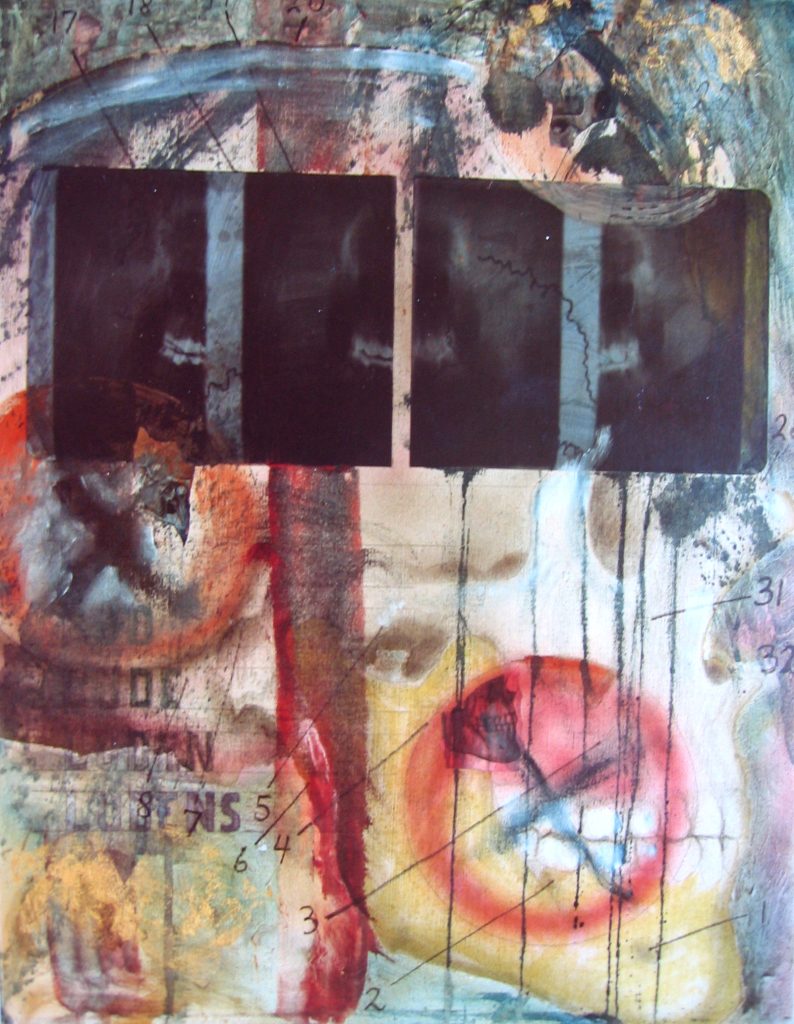
I made my debut as a Danish artist at Charlottenborg’s Spring Exhibition in 1982 with the present work.
I was fascinated by X-ray images and other documentation of our ability to examine the human body, and, for that matter, everything else. This led me to paint many images of bones and to create works that explored how we humans willingly entrust our vulnerable bodies to others, so long as they wear white coats and carry the authority that comes with them.
Visual Composition and Technique
- Mixed Media and Texture: The use of oil paint, gold leaf, and X-ray imagery creates a rich, tactile surface that draws the viewer in. The gold leaf adds a luminous quality, contrasting with the darker, more somber tones of the oil paint and the eerie transparency of the X-ray elements. This juxtaposition evokes a sense of depth and mystery, as if the artwork is revealing hidden layers beneath the surface.
- Color Palette: The palette is dominated by earthy tones, ochres, umbers, and muted reds, punctuated by the stark black of the X-ray panels. The gold leaf introduces a metallic contrast, symbolizing both opulence and fragility. The red hues, reminiscent of flesh or blood, add a visceral quality, reinforcing the theme of the human body and its vulnerabilities.
- Form and Structure: The composition is fragmented, with the three dark rectangular panels resembling X-ray plates or windows into another world. These panels create a sense of division, as if the artwork is a portal or a barrier between the visible and the invisible. The organic, almost chaotic brushstrokes and textures surrounding these panels suggest the unpredictability of life and the body.
Thematic and Conceptual Depth
- Exploration of the Human Body: The inclusion of X-ray imagery directly ties the work to themes of medical examination, vulnerability, and the human condition. The X-rays symbolize our desire to see beyond the surface, to understand what lies beneath the skin, both literally and metaphorically. This aligns with your earlier statement about the fascination with how humans entrust their bodies to medical authority.
- Authority and Trust: The artwork seems to question the relationship between authority (represented by the gold leaf, which often symbolizes power, divinity, or prestige) and the human body. The gold leaf could be interpreted as the “white coat” of medical professionals, highlighting the trust we place in those who hold authority over our physical well-being.
- Fragmentation and Identity: The fragmented composition may reflect the fragmented nature of human identity and experience. The numbers and markings on the canvas could symbolize the clinical, almost dehumanizing way in which the body is analyzed and categorized in medical contexts.
Contextual and Historical Significance
- 1981 Context: Created in 1981, this work emerges from a period of significant cultural and technological shifts. The early 1980s saw advancements in medical imaging technology, which likely influenced the artist’s fascination with X-rays. Additionally, this era was marked by a growing awareness of the ethical implications of medical authority, making the artwork’s themes particularly relevant.
- Size and Presence: At approximately 80 x 50 cm, the artwork is intimate yet commanding. Its size invites close inspection, allowing viewers to engage with its intricate details and textures. The physical presence of the piece reinforces its emotional and conceptual weight.
Artistic Influences and Style
- Surrealism and Abstract Expressionism: The artwork bears traces of Surrealism, particularly in its dreamlike, fragmented imagery and the juxtaposition of unexpected elements (e.g., X-rays and gold leaf). There’s also a nod to Abstract Expressionism in the gestural brushwork and emphasis on emotional and psychological depth.
- Symbolism: The use of gold leaf and X-rays is highly symbolic. Gold leaf often represents permanence, spirituality, or value, while X-rays symbolize revelation, vulnerability, and the unseen. Together, they create a tension between the sacred and the scientific, the eternal and the ephemeral.
Critical Reception and Impact
- Provocative and Thought-Provoking: This artwork challenges viewers to confront their own relationships with authority, trust, and the human body. Its layered symbolism and mixed-media approach make it a compelling piece for discussion and interpretation.
- Innovative Use of Materials: The combination of traditional oil painting with unconventional materials like gold leaf and X-rays demonstrates a bold and innovative approach. This experimentation pushes the boundaries of what painting can achieve, both visually and conceptually.
Conclusion
This 1981 mixed-media artwork is a powerful exploration of the human body, medical authority, and the tension between visibility and concealment. Its rich textures, symbolic use of materials, and fragmented composition invite viewers to reflect on their own vulnerabilities and the trust they place in systems of authority. The piece stands as a testament to the artist’s ability to merge technical skill with profound conceptual depth, making it a significant work of its time.