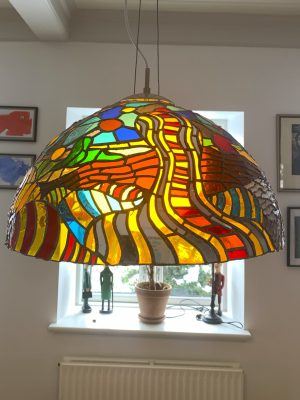
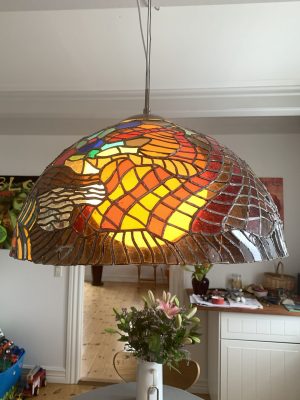
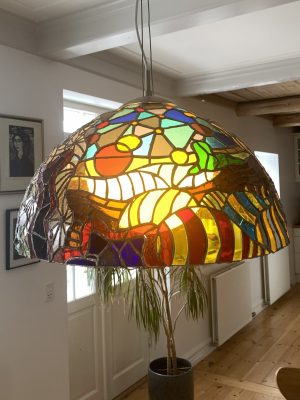
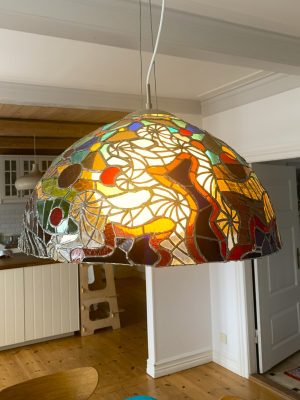
This lamp, which I began in the early 1980s, is far more than an object of illumination. It is a vessel for a specific kind of energy, a physical remnant of a decade where we truly believed the world could be remapped through music, color, and a bit of collective wandering. I titled it “The Magical Tour” because, like the songs of the Beatles or the defiant grit of the Stones, it was never meant to be a straight line. It was meant to be an experience.
When you look at the variation of intertwined forms, you are seeing the mental geography of that era. There are road structures that wind and bend, not because they are lost, but because the best parts of the journey happen when you lose the map. These paths are carved in lead and glass to remind us that progress is rarely linear. We move through life in a series of curves and sudden turns, much like the riffs of a psychedelic guitar solo that refuses to end.
Then, there are the stars and the corals. I wanted to marry the celestial with the oceanic, the highest points of our aspirations with the deep, quiet mysteries of the reef. In the late sixties and through the seventies, we learned that the “inner space” of our own minds was just as vast as the outer space we were busy exploring. By placing stars next to coral structures, I am suggesting that the universe is a single, breathing organism. We are as much a part of the tide as we are the constellations.
The lamp looks the way it does because life itself is a crowded, beautiful, and slightly chaotic composition. It is a messy harmony. There are sections where the glass is thick and dark, representing the heavy moments we all must carry, and then there are the bursts of amber and crimson where the light finally breaks through. It is a “Tour” because you cannot see it all at once. You have to move around it. You have to wait for the sun to hit a certain facet or for the bulb inside to cast a new shadow on your wall.
After spreading light in more than ten places where we have lived, the lamp is now resting over the dining table in our family commune. It has become a steady anchor in a life of movement. Now, I have the daily pleasure of reaching up to draw on the inner bowl together with my two year young grandchild. We create new worlds on the glass. Faces, of course, lots of faces.
I suppose there is a bit of humor in the complexity of it all. It is a bit like a Rolling Stones concert in 1968, loud, vibrant, slightly dangerous, and filled with more layers than one person can fully process in a single sitting. I made it to be a companion for the dreamers. It is a reminder that even when the world feels fragmented, like a thousand pieces of broken glass, there is a way to bind them together with enough heat, lead, and a stubborn belief in the magic of the tour.