EXECUTIVE SUMMARY
This project will be paving the way for establishing a facility, which will provide affordable cooking fuel for low-income families in and around urban areas in Southern Africa.
Both Project Phase 1 and 2 are described, in as much detail as possible in order to bring a full holistic view to the reader. The immediate support from SDC will only cover activities in Phase 1.
However, we will start to seek funding from other funding sources as well, to cover the costs of phase 2, as soon as the agreement for Phase 1 is in place.
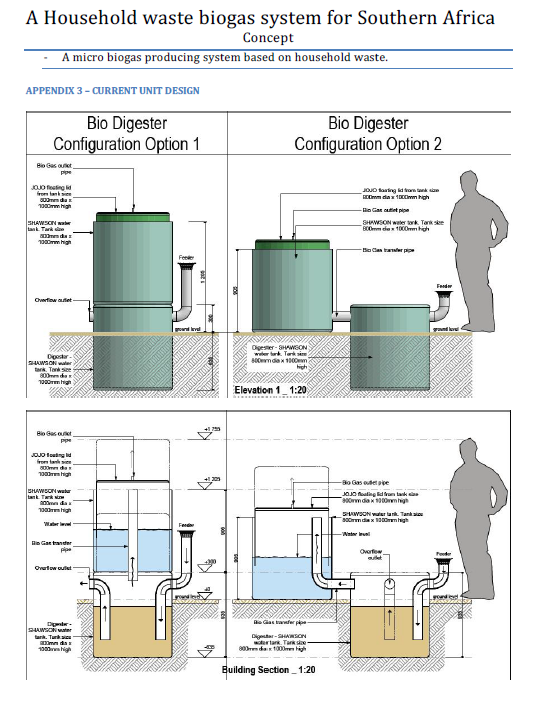
Project background Both in India, Nepal and China the use of Household waste based Biogas Systems, have been produced and used for a number of years. In Nepal 208,000 biogas plants installed by 2010, benefitting 1.25 million people across the country. 420,000 tons/year less fuel wood, burnt 630,000 tons/year Co2 saved. And with the plants has come an infrastructure of installers and finance institutions, and over 6,000 people trained. We would like to introduce the same technology to the Southern African market. The average poor home in South Africa spend 25% of its income on energy of which 90-100% is for cooking. 25% which can be saved by providing these families with a HWB. To our knowledge the technology has not been introduced to the SA market and produced in an industrial fashion. It is estimated that 6 mill. South African homes will be able to benefit from such a set-up. Strategic Environmental Focus (SEF) and Danish Energy Management (DEM) have formed a partnership, supported by the DANIDA Business to Business programme, which also contains a CSR component. We have supported LESEDI School, located in the Mamelodi area of Pretoria and are trying to introduce them to Rainwater harvesting, Vegetable Gardening, Energy Efficiency and other environmental issues, with information, training and education. The school and its surrounding community will be the target for the initial trial (9 units) and also part of the more extensive role out of 990 units. Besides Pretoria, Durban and Cape Town will also be targeted as part of the role out.