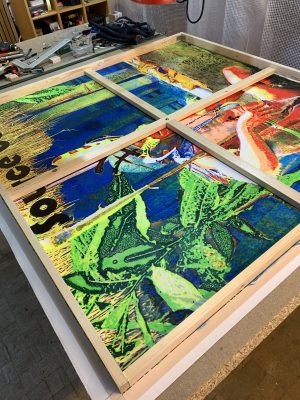
I finally had the opportunity to go big. Well, not monumental perhaps, but 150 x 150 cm, certainly large enough to pose a logistical nightmare for my compact car. While my car cannot accommodate a massive square frame, it can easily handle something 150 cm long and 20 cm in diameter.
This sparked a challenge. Being an optimist, I assumed others in the art world—those of us operating without massive budgets—must have faced this same wall. Surely, many artists have had to scale down simply because transport costs became insurmountable. I began asking around, but the answers I received were vague and unhelpful. It seemed the standard solution was either to have deep pockets or to let the exhibition venue foot the bill. Neither was an option for me. I had to find my own way.
My first thought was simplicity itself: mount a wooden slat at the top and bottom and let gravity do the work. I even considered using a heavy RHS steel profile at the bottom to give the canvas some real tension. I figured if I secured the slats with high-quality Velcro, it would hold. The whole thing could be rolled up, tucked into my car, or shipped affordably. It was a start, but I was not satisfied. I wanted the structural integrity of a “real” stretcher bar; I did not want my work to stand out because of a makeshift hanging system.
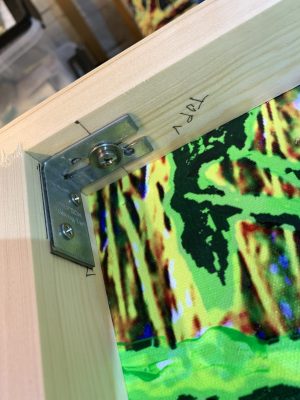
The idea of the top and bottom slats worked, but what if I added detachable side bars? That would allow for a stabilizing cross-brace. I experimented with Velcro and screw-on corner brackets, but the tension haunted me. Could Velcro really handle the pull? Would the canvas stay taut over time? I kept brooding over the mechanics.
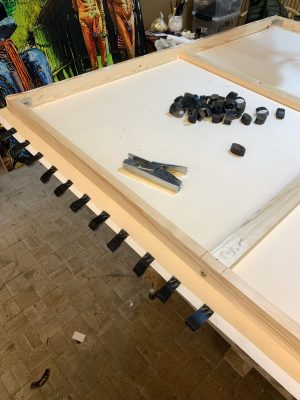
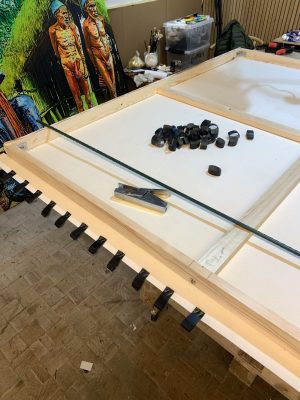
Then, a breakthrough: what if I used elastic tensioners on the edges of the canvas, pulling them toward the inside of the frame?
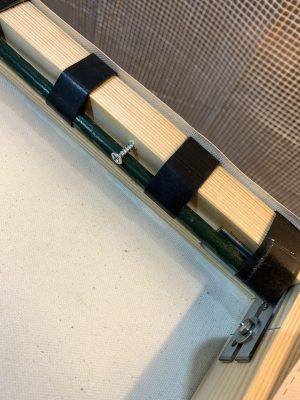
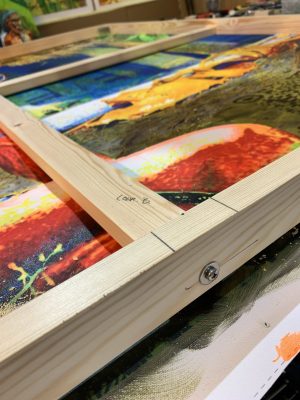
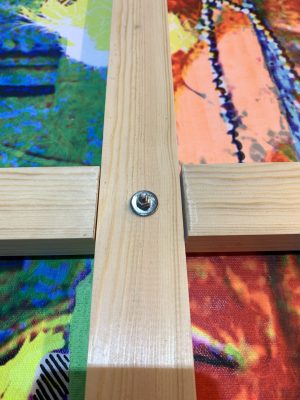
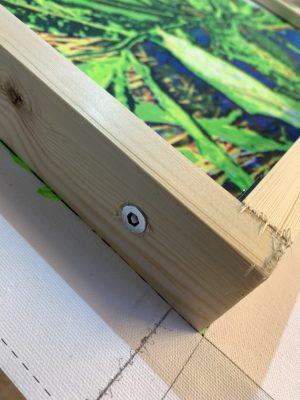
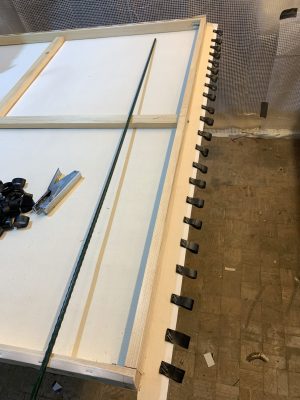
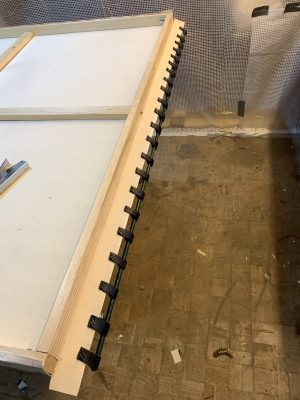
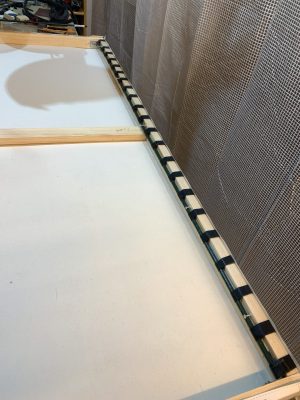
I headed to the local bike shop and asked if they had any old, punctured inner tubes. The shopkeeper dived into his scrap bin and handed me two leaky tubes. I was thrilled. Next, I picked up two 150 cm aluminum rods and rushed back to the studio. I cut the inner tubes into 15 mm strips and stapled them to the sides of the canvas. I then threaded the aluminum rods through these elastic loops, pulled the rods toward the back of the wooden frame, and secured them with screws.
Let me just say: it worked perfectly. The joy was immense. I had found the solution. I can now assemble and disassemble my frames at will. I can roll the entire artwork, pop it into a tube, and ship it with a simple set of instructions—or just toss it in the back of my small car and drive. I no longer have to choose between the scale of my vision and the size of my vehicle.